
The Drone Revolution and the Transformation of Modern Warfare
From Platform-Centric Warfare to Network-Centric Dominance
The operational landscape emerging from the world’s principal conflict zones over the past two months points to a profound transformation in the character of contemporary warfare. The scale, sophistication, and operational tempo of unmanned aerial vehicle (UAV) employment indicate that drones have evolved beyond their traditional role as tactical support assets into strategic instruments capable of reshaping military doctrine, force structure, and the global balance of power.
For more than a century, military superiority was fundamentally measured by the possession of increasingly sophisticated platforms, fighter aircraft, armored formations, strategic bombers, aircraft carriers, and advanced missile systems. Today, however, the decisive factor is shifting from the individual platform to the integrated network. Modern combat effectiveness increasingly depends on the seamless fusion of autonomous systems, artificial intelligence, satellite reconnaissance, electronic warfare, cyber capabilities, and real-time command-and-control architectures.
Military power in the twenty-first century will therefore be determined less by the quantity of conventional platforms and more by the ability to collect, process, disseminate, and exploit information faster than one’s adversary while orchestrating thousands of autonomous systems within a unified operational ecosystem.
Ukraine: The Laboratory of Twenty-First Century Warfare
The war in Ukraine has evolved into the most significant testing ground for the future of modern warfare.
Recent large-scale aerial assaults against Kyiv, involving hundreds of drones coordinated with cruise and ballistic missiles, illustrate the emergence of saturation warfare. Rather than relying exclusively on precision strikes against isolated targets, these operations seek to overwhelm integrated air-defense systems through simultaneous, multidirectional attacks that exhaust interception capabilities and degrade command-and-control effectiveness.
At the same time, Ukraine continues to expand its long-range strike campaign deep inside Russian territory, targeting oil refineries, fuel depots, military airfields, logistics hubs, and defense-industrial infrastructure. These operations demonstrate that relatively inexpensive unmanned systems can impose disproportionate strategic costs by disrupting supply chains, degrading industrial capacity, and challenging the traditional concept of strategic depth.
Beyond Eastern Europe, similar operational patterns have become increasingly evident. In Sudan, the United Nations has documented a sharp increase in drone attacks during fighting between rival armed forces, resulting in significant civilian casualties and widespread infrastructure damage. Meanwhile, sustained UAV attacks against Ukrainian cities such as Sumy and Nikopol further illustrate that drones have become central instruments of attritional warfare and strategic coercion.
Collectively, these developments suggest that the ongoing conflicts are not merely regional wars; they are shaping the future doctrine of global military operations.
The Economics of Attrition
Perhaps the most consequential transformation concerns the economics of warfare itself.
A drone costing ten of thousands of dollars can compel the launch of interceptor missiles worth several million dollars or inflict damage on infrastructure valued hundreds of times more than the attacking platform. This asymmetric cost equation fundamentally alters traditional military planning.
The battlefield is increasingly governed by an economics of attrition, where success is measured not solely by destructive capability but by the relationship between operational cost and strategic effect.
This shift enables states with comparatively limited defense budgets to generate disproportionate military and economic pressure against conventionally superior opponents, thereby redefining long-standing assumptions regarding deterrence, force projection, and military superiority.
Artificial Intelligence, Network-Centric Warfare, and the Kill Chain
The true revolution extends well beyond the drones themselves.
Its defining characteristic lies in the integration of autonomous platforms with satellite systems, artificial intelligence, cyber operations, electronic warfare, and distributed sensor networks into a single operational architecture.
The long-discussed concept of Network-Centric Warfare is rapidly becoming an operational reality.
Within this ecosystem, drones function simultaneously as reconnaissance assets, intelligence collectors, electronic warfare platforms, communication relays, precision strike systems, and autonomous battlefield sensors.
Consequently, decision superiority increasingly outweighs platform superiority.
Victory will belong to the force capable of compressing the kill chain, detect, identify, decide, and engage, more rapidly than its adversary while maintaining uninterrupted information superiority across every operational domain.
Drone Swarms and the Redefinition of Air Defense
The emergence of coordinated drone swarms represents one of the greatest technological challenges confronting modern air-defense systems.
Saturation attacks are designed not merely to penetrate defensive networks but to overwhelm them by forcing defenders to engage hundreds of simultaneous targets.
This strategy rapidly depletes interceptor inventories, imposes unsustainable financial costs, and places continuous pressure on command-and-control systems.
As a result, traditional air-defense doctrines, developed primarily to counter limited numbers of aircraft or ballistic missiles, are increasingly inadequate against persistent, low-cost, massed autonomous attacks.
Future air-defense architectures will likely prioritise layered defenses, directed-energy weapons, electronic warfare, artificial intelligence-assisted target discrimination, and low-cost interception technologies.
The Geopolitics of the Global Drone Industry
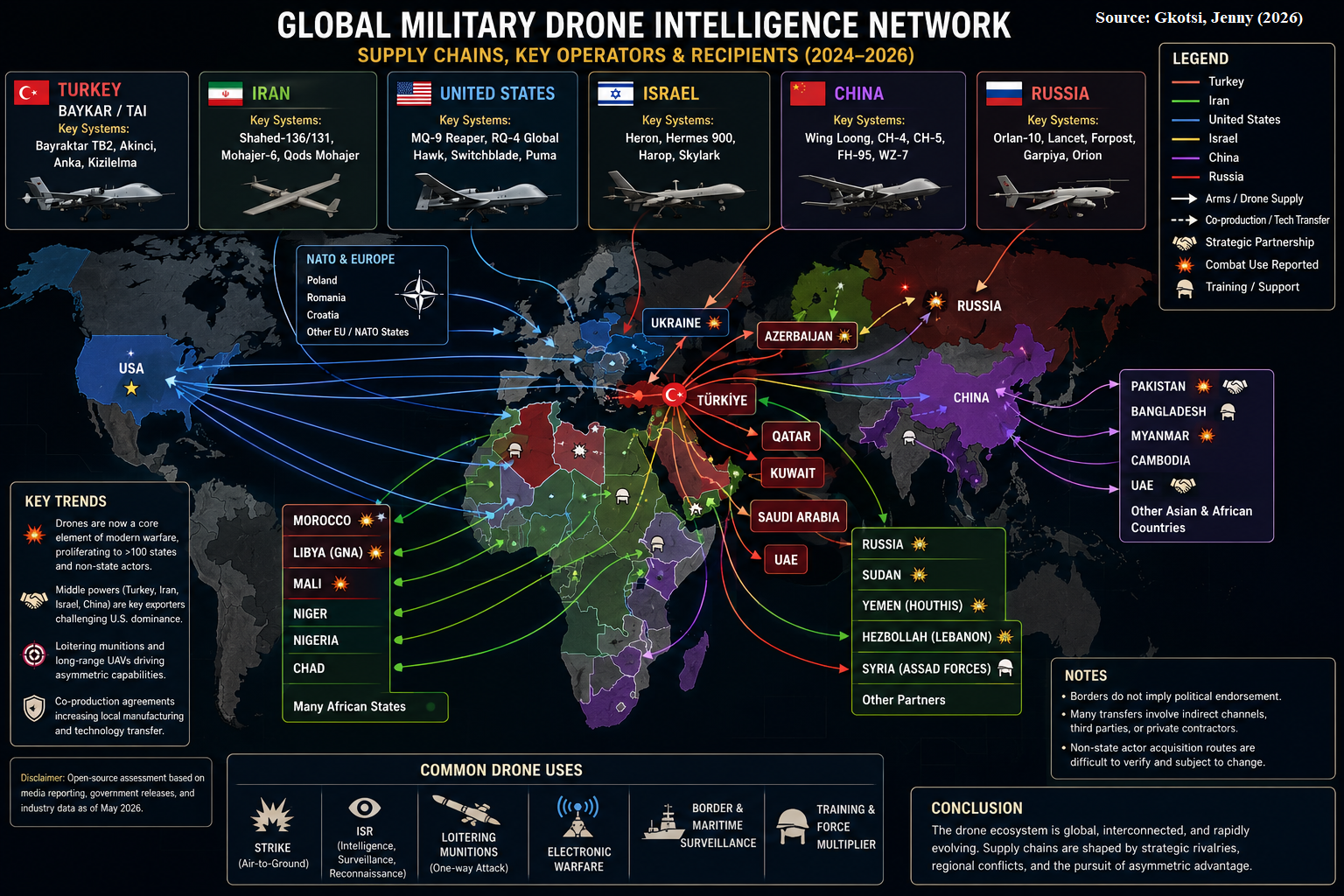
The rapid proliferation of UAV technology is simultaneously reshaping the international defense-industrial landscape.
Turkey has emerged as one of the world’s leading drone exporters, transforming defense manufacturing into an instrument of geopolitical influence and strategic diplomacy.
Iran has leveraged relatively inexpensive attack drones and loitering munitions to expand regional influence through state and non-state partners, demonstrating how unmanned systems can serve as force multipliers in asymmetric conflicts.
The United States and Israel continue to dominate the technological frontier of advanced unmanned systems, while China steadily expands its global footprint through competitive exports across Asia, Africa, and the Middle East.
Meanwhile, Russia has accelerated domestic UAV production while deepening industrial cooperation with Iran, underscoring the growing importance of international production networks in sustaining prolonged conflicts.
Consequently, the global drone industry has evolved into a strategic indicator of geopolitical influence, comparable to the role that fighter aircraft exports played during the Cold War.
Strategic Implications
The evidence emerging from contemporary conflicts suggests that warfare is entering a fundamentally new era.
The future battlefield will be characterized by persistent surveillance, distributed autonomous operations, artificial intelligence-enabled decision-making, cyber-electromagnetic integration, and multidomain command-and-control networks operating at unprecedented speed.
Military superiority will increasingly depend not on the number of tanks, combat aircraft, or naval vessels a nation possesses, but on its capacity to integrate autonomous systems, space-based assets, cyber capabilities, artificial intelligence, and electronic warfare into a resilient and adaptive operational ecosystem.
Drones are unlikely to replace conventional military forces entirely. Rather, they are redefining the principles by which military power is generated, projected, and sustained. They are transforming procurement priorities, operational doctrine, defense-industrial strategy, and the economics of conflict itself.
The next decade is therefore unlikely to be defined by competition over who manufactures the greatest number of drones, but by who develops the most intelligent, autonomous, networked, and interoperable unmanned systems.
Artificial intelligence, collaborative autonomy, distributed sensing, and machine-speed decision-making are poised to become the defining determinants of military effectiveness in the twenty-first century.
The ongoing drone revolution should therefore be understood not as a technological innovation alone, but as a paradigm shift in military affairs, comparable in strategic significance to the emergence of air power in the early twentieth century or the advent of nuclear weapons after the Second World War. States capable of integrating these technologies into coherent military doctrine, industrial capacity, and national strategy will be best positioned to shape the future balance of power in an increasingly contested international security environment.
References:
- Atlantic Council
- Baykartech
- Center for Strategic and International Studies
- EU
- Institute for the Study of War
- International Institute for Strategic Studies
- NATO
- RAND Corporation
- Reuters
- Royal United Services Institute
- Stockholm International Peace Research Institute
- UN


Discover more from Lobby Global
Subscribe to get the latest posts sent to your email.
